
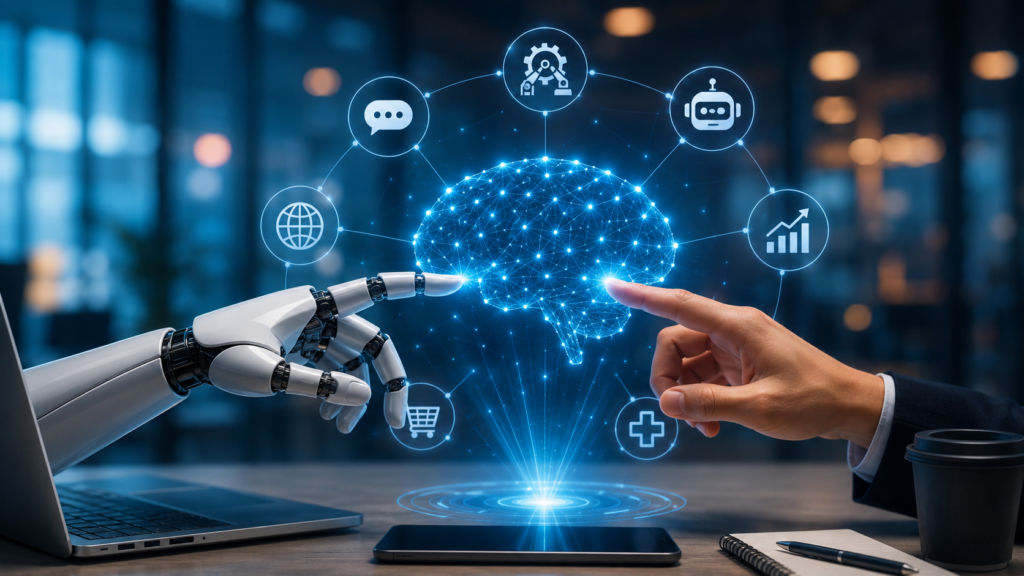
Artificial intelligence (AI) is no longer a concept reserved for technology companies or research labs. It has become part of everyday life, influencing how we work, communicate, shop, learn, and make decisions. From virtual assistants and recommendation engines to advanced business analytics and medical diagnostics, AI is reshaping industries and personal experiences alike.
For organizations, AI offers opportunities to improve efficiency, reduce costs, enhance customer experiences, and uncover valuable insights from data. For individuals, it simplifies everyday tasks, provides personalized services, and helps people access information faster than ever before.
Yet successful AI adoption involves more than simply deploying new technology. It requires thoughtful planning, quality data, responsible governance, employee engagement, and a clear understanding of where AI can deliver meaningful value. This guide explores how AI works, where it is being used, the challenges organizations face, and what the future may hold.
What Is Artificial Intelligence?
Artificial intelligence refers to computer systems that can perform tasks that normally require human intelligence. These tasks may include understanding language, recognizing patterns, analyzing data, making predictions, solving problems, or generating content.
Unlike traditional software that follows fixed rules, AI systems can learn from data and improve their performance over time. This ability allows AI to adapt to changing situations and produce more accurate results.
Examples of AI include:
- Voice assistants
- Chatbots
- Recommendation systems
- Image recognition tools
- Language translation software
- Predictive analytics platforms
- Autonomous vehicles
AI exists across a wide spectrum, ranging from simple automation tools to sophisticated systems capable of processing large volumes of information and supporting complex decisions.
AI, Automation, and Machine Learning: Understanding the Difference
Many people use these terms interchangeably, but they are not the same.
Automation
Automation follows predefined rules to complete repetitive tasks. For example, an automated email response or scheduled invoice generation system performs actions based on specific instructions.
Machine Learning
Machine learning is a branch of AI that enables systems to learn from data rather than relying entirely on programmed rules. A machine learning model identifies patterns and improves predictions as it processes more information.
Artificial Intelligence
AI is the broader concept that includes machine learning and other technologies that simulate aspects of human intelligence. AI systems can analyze information, understand language, make recommendations, and support decision-making.
In simple terms, automation follows rules, machine learning learns from data, and AI combines multiple capabilities to solve problems intelligently.
Why AI Has Become a Strategic Priority
Organizations across nearly every industry are investing in AI because of its ability to improve productivity and create competitive advantages.
Several factors have accelerated AI adoption:
- Increased availability of digital data
- Faster computing power
- Cloud-based technology platforms
- Growing customer expectations
- Advances in machine learning models
- Demand for operational efficiency
Companies are increasingly looking for ways to streamline workflows, reduce manual work, improve customer experiences, and make faster, data-driven decisions.
At the same time, individuals are embracing AI-powered tools that help them manage daily tasks, access information, and improve productivity.
How AI Is Used in Everyday Life
Many people interact with AI every day without realizing it.
Smart Assistants
Virtual assistants can answer questions, set reminders, manage calendars, and control smart devices through voice commands.
Personalized Recommendations
Streaming services, online retailers, and social media platforms use AI to recommend content based on user preferences and behavior.
Navigation and Travel
GPS applications use AI to analyze traffic conditions, predict travel times, and suggest optimal routes.
Online Search
Search engines rely on AI to understand user intent and deliver relevant results.
Language Translation
AI-powered translation tools help people communicate across different languages more effectively.
Smart Home Technology
Connected devices can learn household routines, optimize energy usage, and automate daily activities.
These applications demonstrate how AI has become integrated into daily life, often operating quietly in the background.
AI Adoption Across Industries
Businesses are finding innovative ways to apply AI in a wide range of sectors.
Customer Service
AI-powered chatbots and virtual assistants help organizations provide support around the clock.
Benefits include:
- Faster response times
- Reduced support costs
- Improved customer satisfaction
- Consistent service delivery
Human agents remain essential for complex issues, but AI can handle many routine inquiries efficiently.
Marketing and Sales
Marketing teams use AI to analyze customer behavior, personalize campaigns, and improve targeting.
Common applications include:
- Customer segmentation
- Content recommendations
- Lead scoring
- Marketing automation
- Predictive analytics
These capabilities help businesses deliver more relevant experiences while improving campaign performance.
Healthcare
Healthcare organizations use AI to support diagnosis, treatment planning, medical imaging analysis, and administrative tasks.
Examples include:
- Disease detection
- Medical image interpretation
- Personalized treatment recommendations
- Drug discovery research
- Patient monitoring systems
AI supports healthcare professionals rather than replacing them, helping improve efficiency and accuracy.
Finance
Financial institutions use AI to detect fraud, assess risk, automate compliance processes, and improve customer service.
Applications include:
- Fraud detection
- Credit scoring
- Investment analysis
- Financial forecasting
- Automated customer support
These systems help organizations process large volumes of financial data quickly and accurately.
Education
Educational institutions use AI to create personalized learning experiences and support students.
Benefits include:
- Adaptive learning platforms
- Automated grading
- Student performance analysis
- Personalized study recommendations
- Language learning support
AI helps educators spend more time on instruction while supporting individual learning needs.
Operations and Supply Chains
Businesses use AI to improve logistics, inventory management, forecasting, and production planning.
Key advantages include:
- Better demand forecasting
- Reduced waste
- Improved inventory control
- Enhanced operational efficiency
- Faster decision-making
Organizations can respond more effectively to market changes and customer demand.
The Benefits of AI Adoption
When implemented thoughtfully, AI can deliver significant benefits.
Improved Efficiency
AI automates repetitive tasks, allowing employees to focus on higher-value work.
Better Decision-Making
Advanced analytics help organizations identify trends and make informed decisions.
Enhanced Customer Experiences
Personalized interactions can improve satisfaction and customer loyalty.
Cost Reduction
Automation and process optimization can lower operational expenses.
Increased Innovation
AI helps organizations explore new products, services, and business models.
Competitive Advantage
Businesses that successfully leverage AI often gain insights and efficiencies that competitors may struggle to match.
Common Challenges in AI Implementation
Despite its potential, AI adoption is not without obstacles.
Data Quality Issues
AI systems depend on reliable data. Incomplete, outdated, or inaccurate information can reduce effectiveness.
Organizations should invest in strong data management practices before implementing AI solutions.
Employee Adoption
Employees may be hesitant to embrace new technologies due to uncertainty or concerns about job security.
Clear communication, training, and involvement in the implementation process can help build confidence and acceptance.
Cost Considerations
Developing, deploying, and maintaining AI systems can require significant investment.
Organizations should identify clear business objectives and expected returns before launching large-scale projects.
Integration Complexity
Many companies must integrate AI tools with existing systems and workflows.
Successful implementation often requires collaboration between business leaders, technical teams, and operational staff.
Security and Privacy Concerns
Organizations must protect sensitive information and comply with privacy regulations when using AI technologies.
Strong governance frameworks are essential for managing these risks.
Responsible AI and Ethical Considerations
As AI becomes more powerful, responsible use becomes increasingly important.
Organizations should focus on:
Transparency
Users should understand when AI is being used and how decisions are made.
Fairness
AI systems should be designed to reduce bias and avoid unfair outcomes.
Accountability
Organizations must remain responsible for decisions influenced by AI systems.
Privacy Protection
Personal information should be handled securely and in accordance with applicable regulations.
Human Oversight
Critical decisions should involve human review when necessary.
Responsible AI practices help build trust among customers, employees, regulators, and stakeholders.
How Businesses Can Successfully Adopt AI
Organizations often achieve the best results when they take a structured approach.
1. Define Clear Objectives
Identify specific business problems that AI can help solve.
2. Assess Data Readiness
Evaluate data quality, accessibility, and governance practices.
3. Start Small
Pilot projects allow organizations to test solutions before expanding adoption.
4. Involve Employees
Engage teams early and provide training to encourage adoption.
5. Measure Results
Track performance metrics to determine whether AI initiatives deliver expected outcomes.
6. Strengthen Governance
Establish policies for privacy, security, compliance, and ethical AI usage.
7. Continuously Improve
AI systems require ongoing monitoring and refinement to remain effective.
The Future of AI in Business and Society
AI adoption is expected to continue accelerating across industries and daily life.
Several trends are likely to shape the future:
- More personalized digital experiences
- Advanced predictive analytics
- Increased workplace automation
- AI-powered healthcare innovations
- Smarter education technologies
- Greater focus on ethical AI governance
- Expanded use of generative AI tools
As technology evolves, organizations that balance innovation with responsibility will be best positioned to benefit.
The future of AI is not about replacing people. Instead, it is about enhancing human capabilities, improving productivity, and helping individuals and organizations solve increasingly complex challenges.
FAQ Section
1. What is artificial intelligence in simple terms?
Artificial intelligence is technology that enables computers to perform tasks that normally require human thinking, such as learning, problem-solving, language understanding, and decision-making.
2. How is AI different from automation?
Automation follows fixed rules, while AI can learn from data, adapt to new information, and make predictions or recommendations.
3. What industries benefit most from AI?
Healthcare, finance, education, retail, manufacturing, logistics, and customer service are among the industries seeing significant benefits from AI adoption.
4. Does AI replace human workers?
AI typically automates repetitive tasks and supports decision-making, allowing employees to focus on creative, strategic, and relationship-based work.
5. What is responsible AI?
Responsible AI refers to developing and using AI systems in ways that are transparent, fair, secure, ethical, and accountable.
Final Thoughts
Artificial intelligence is transforming both business operations and everyday experiences. Its applications span customer service, healthcare, finance, education, marketing, and countless other areas. While AI offers substantial opportunities for efficiency, innovation, and growth, successful adoption requires careful planning, quality data, employee engagement, and responsible governance.
Organizations that approach AI thoughtfully can unlock meaningful value while maintaining transparency, trust, and accountability. For individuals, AI offers tools that simplify daily life and improve access to information and services. As adoption continues to grow, understanding how AI works and how to use it responsibly will become an increasingly important skill for businesses and society alike.