
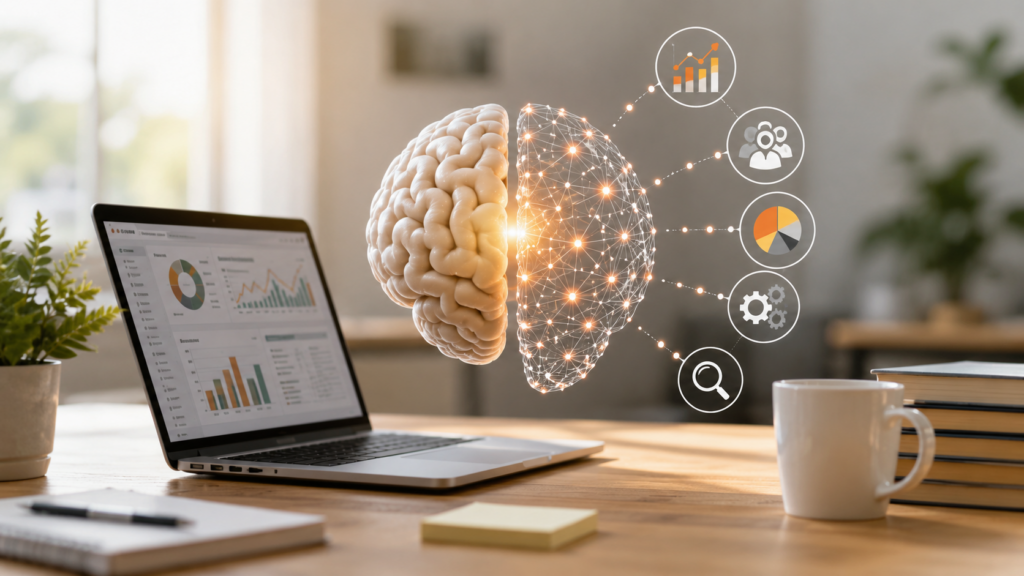
Machine learning has become one of the most influential technologies of the modern era. It powers everything from personalized shopping recommendations and fraud detection systems to voice assistants and medical research. Yet despite its growing presence, many people still view machine learning as something highly technical and difficult to understand.
The reality is much simpler. At its core, machine learning is about teaching computers to learn from data and improve their performance over time without being explicitly programmed for every situation.
As organizations generate more data than ever before, machine learning helps uncover patterns, predict outcomes, automate tasks, and support better decision-making. Understanding how it works can help businesses, professionals, and everyday consumers make sense of the technologies shaping the world around them.
What Is Machine Learning?
Machine learning is a branch of artificial intelligence that enables computers to learn from data and make decisions or predictions based on what they have learned.
Traditional software follows fixed rules created by programmers. Machine learning systems work differently. Instead of relying solely on predefined instructions, they identify patterns in large amounts of data and use those patterns to make future predictions.
For example, rather than manually defining every characteristic of spam emails, a machine learning model analyzes thousands of examples of spam and legitimate messages. Over time, it learns how to recognize suspicious emails on its own.
The more relevant and accurate data it receives, the better its performance typically becomes.
Why Machine Learning Matters
Modern organizations collect enormous amounts of information from websites, mobile apps, customer interactions, sensors, transactions, and connected devices.
Without machine learning, analyzing such large datasets would be slow and often impractical.
Machine learning helps organizations:
-
- Identify trends and patterns
- Improve customer experiences
- Detect unusual behavior
- Forecast future outcomes
- Automate repetitive tasks
- Reduce operational costs
- Make faster decisions
From healthcare and finance to retail and manufacturing, machine learning is becoming a key driver of innovation and efficiency.
How Machine Learning Works
Although machine learning can appear complex, the process generally follows a straightforward sequence.
1. Data Collection
Everything begins with data.
The system gathers information from various sources such as:
- Customer purchases
- Website activity
- Financial transactions
- Sensor readings
- Images and videos
- Medical records
The quality of the data significantly influences the quality of the results.
2. Data Preparation
Raw data often contains errors, missing information, duplicates, or inconsistencies.
Before training begins, the data is cleaned and organized to ensure accuracy and reliability.
This stage frequently consumes a significant portion of machine learning projects because poor-quality data leads to poor outcomes.
3. Model Training
The machine learning model studies historical data and searches for meaningful patterns.
During training, it learns relationships between different variables and develops methods for making predictions or classifications.
4. Testing and Evaluation
The model is then tested using data it has not seen before.
This helps determine whether it can make accurate predictions in real-world situations rather than simply memorizing training examples.
5. Deployment and Improvement
Once validated, the model is deployed into production systems.
As new data becomes available, organizations often retrain models to maintain accuracy and adapt to changing conditions.
Understanding Supervised Learning
Supervised learning is the most widely used machine learning approach.
In supervised learning, the model learns from labeled data. This means the correct answers are already known during training.
For example:
- Predicting house prices based on historical sales data
- Identifying fraudulent transactions
- Predicting customer churn
- Forecasting product demand
The model studies examples and learns the relationship between inputs and outputs.
Once trained, it can make predictions for new situations.
Common Supervised Learning Applications
- Credit risk assessment
- Email spam filtering
- Sales forecasting
- Medical diagnosis support
- Customer behavior prediction
Understanding Unsupervised Learning
Unsupervised learning works differently.
Instead of receiving labeled examples, the model analyzes data and discovers hidden patterns independently.
It identifies similarities, groups, and relationships that may not be immediately obvious.
For example, a retailer may use unsupervised learning to discover groups of customers with similar buying habits.
Common Unsupervised Learning Applications
- Customer segmentation
- Market research
- Product recommendation systems
- Network analysis
- Behavioral pattern discovery
Because it reveals insights without predefined categories, unsupervised learning is particularly useful for exploration and discovery.
What Are Neural Networks?
Neural networks are machine learning models inspired by how the human brain processes information.
They consist of interconnected layers that analyze data and gradually learn complex relationships.
Neural networks are particularly effective when dealing with:
- Images
- Speech recognition
- Language processing
- Video analysis
- Complex prediction tasks
Many of today’s most recognizable AI tools rely on neural networks.
Virtual assistants, image recognition systems, language translation platforms, and advanced chatbots all use variations of neural network technology.
Predictive Analytics and Forecasting
One of the most valuable uses of machine learning is predictive analytics.
Predictive analytics uses historical data to estimate future outcomes.
Organizations use these insights to improve planning, reduce risks, and allocate resources more effectively.
Examples include:
- Forecasting sales demand
- Predicting equipment failures
- Identifying customers likely to cancel subscriptions
- Estimating insurance risks
- Anticipating inventory needs
Rather than reacting to problems after they occur, businesses can proactively prepare for future events.
Real-World Machine Learning Applications
Machine learning affects daily life far more than many people realize.
Personalized Recommendations
Streaming platforms, online retailers, and social media networks use machine learning to recommend content based on user behavior.
These systems analyze viewing habits, purchases, searches, and interactions to provide personalized experiences.
Fraud Detection
Financial institutions use machine learning to identify suspicious transactions in real time.
The system recognizes unusual spending patterns and flags potentially fraudulent activity before significant damage occurs.
Predictive Maintenance
Manufacturers increasingly rely on machine learning to monitor machinery and equipment.
By analyzing sensor data, models can predict failures before breakdowns occur, reducing downtime and repair costs.
Healthcare Support
Healthcare organizations use machine learning to assist with diagnosis, treatment planning, patient monitoring, and medical research.
These systems help healthcare professionals identify patterns that may otherwise be difficult to detect.
Customer Service Automation
Many organizations use machine learning-powered chatbots and virtual assistants to handle common customer inquiries.
This improves response times while allowing human teams to focus on more complex issues.
Common Misconceptions About Machine Learning
Despite its popularity, several myths continue to create confusion.
Myth 1: Machine Learning Thinks Like Humans
Machine learning does not possess human understanding, emotions, or reasoning.
It identifies patterns and makes predictions based on data.
Myth 2: More Data Always Means Better Results
Data quality matters more than quantity.
Large volumes of inaccurate or biased data can produce poor outcomes.
Myth 3: Machine Learning Eliminates Human Jobs Entirely
While automation changes certain roles, it often creates new opportunities that require oversight, analysis, strategy, and creativity.
Many organizations use machine learning to augment human capabilities rather than replace them.
Myth 4: Machine Learning Is Fully Autonomous
Successful machine learning systems require ongoing monitoring, maintenance, updates, and governance.
Human involvement remains essential.
Challenges and Risks of Machine Learning
While machine learning offers significant benefits, it also presents important challenges.
Data Quality Issues
Incomplete, inaccurate, or outdated data can reduce model performance and reliability.
Bias and Fairness
If training data contains bias, the model may produce unfair or discriminatory outcomes.
Organizations must regularly evaluate systems for fairness and transparency.
Privacy Concerns
Machine learning often relies on large datasets that may contain personal information.
Strong data protection practices are essential.
Lack of Transparency
Some advanced models can be difficult to interpret.
Organizations increasingly seek explainable AI solutions that make decisions easier to understand.
Changing Conditions
Markets, customer behavior, and external environments evolve constantly.
Models must be updated to remain accurate over time.
Emerging Trends Shaping the Future
Machine learning continues to evolve rapidly.
Several developments are expected to influence future adoption.
Generative AI
Generative AI systems can create text, images, audio, and software code, opening new possibilities across industries.
Automated Machine Learning
Automated tools simplify model development, making machine learning more accessible to non-specialists.
Edge AI
Instead of processing data in centralized servers, machine learning increasingly runs directly on devices such as smartphones, vehicles, and industrial equipment.
Explainable AI
Organizations are investing in solutions that improve transparency and trust in machine learning decisions.
Industry-Specific Applications
More tailored machine learning solutions are emerging for healthcare, finance, logistics, manufacturing, education, and other sectors.
Best Practices for Organizations Adopting Machine Learning
Organizations considering machine learning should focus on practical implementation rather than technology alone.
Key recommendations include:
- Start with a clear business problem.
- Prioritize data quality and governance.
- Set realistic expectations.
- Measure outcomes carefully.
- Monitor performance continuously.
- Address privacy and compliance requirements.
- Invest in employee education and adoption.
The most successful projects focus on solving real problems rather than simply adopting new technology.
Common Questions
1. What is machine learning in simple terms?
Machine learning is a type of artificial intelligence that enables computers to learn from data and improve performance without being explicitly programmed for every task.
2. What is the difference between AI and machine learning?
Artificial intelligence is the broader concept of machines performing intelligent tasks, while machine learning is a specific method that allows systems to learn from data.
3. Where is machine learning used today?
Machine learning is used in recommendation systems, fraud detection, healthcare, marketing, finance, manufacturing, customer service, and many everyday digital applications.
4. Does machine learning require large amounts of data?
Many machine learning models benefit from large datasets, but quality, accuracy, and relevance are often more important than sheer volume.
5. Can small businesses use machine learning?
Yes. Many affordable tools and cloud-based platforms allow small businesses to use machine learning for marketing, forecasting, customer insights, and automation.
Final Overview
Machine learning is no longer a futuristic concept. It is already embedded in many technologies people use every day. From personalized recommendations and fraud detection to predictive maintenance and healthcare support, machine learning is helping organizations make smarter decisions and operate more efficiently.
Understanding the basic concepts behind supervised learning, unsupervised learning, neural networks, predictive analytics, and model training makes the technology far less mysterious. While challenges around data quality, privacy, bias, and transparency remain important considerations, machine learning continues to create new opportunities for innovation across virtually every industry.
As data volumes grow and technology advances, machine learning will likely become an even more important part of how businesses, governments, and individuals solve problems, improve experiences, and make decisions.