
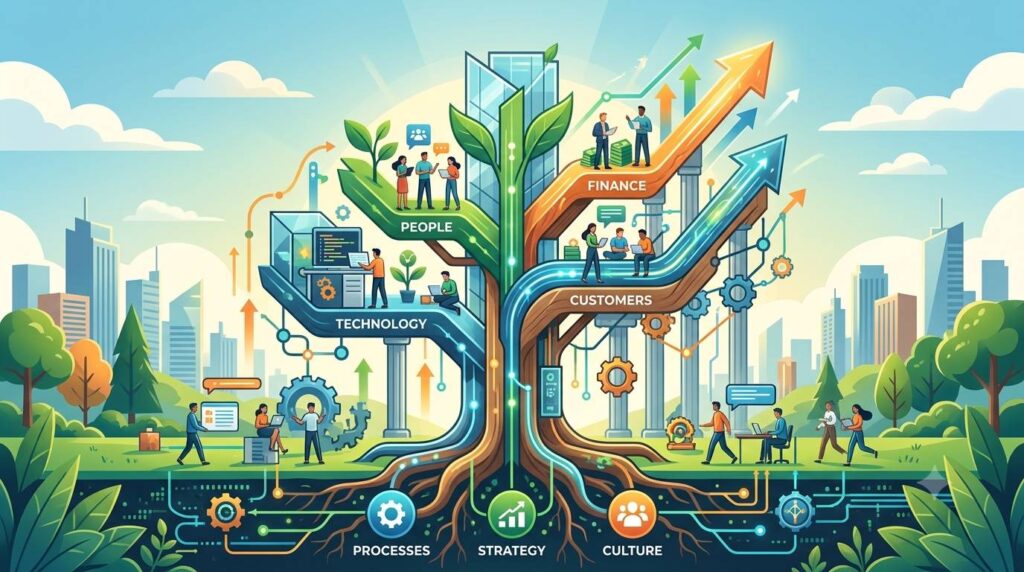
Growing a business is exciting, but growth can quickly become a problem if the business isn’t prepared for it. Many companies focus on increasing revenue, adding customers, or expanding into new markets without building the systems needed to support that growth. The result is often missed deadlines, overwhelmed teams, declining customer satisfaction, and shrinking profits.
Sustainable growth is different. It means growing at a pace your business can support while maintaining quality, profitability, and a positive customer experience. Instead of relying on constant firefighting, sustainable businesses create reliable systems that allow them to expand without losing control.
In this guide, you’ll learn how sustainable growth systems work, why they matter, and the practical steps you can take to build a business that scales smoothly for the long term.
What Is a Sustainable Growth System?
A sustainable growth system is a collection of processes, technology, people, and strategies that allow a business to grow consistently without creating unnecessary complexity.
Rather than depending on one person or a small team to solve every problem, the business develops repeatable systems that keep operations running efficiently as demand increases.
These systems typically cover:
- Sales and lead generation
- Customer onboarding
- Operations and fulfillment
- Financial management
- Marketing automation
- Team communication
- Performance measurement
- Customer support
When these areas work together, growth becomes more predictable and much easier to manage.
Why Businesses Struggle as They Grow
Growth often exposes weaknesses that weren’t obvious when the business was smaller.
Common challenges include:
- Manual processes that no longer keep up with demand
- Poor communication between departments
- Inconsistent customer experiences
- Hiring faster than training
- Cash flow problems despite increasing sales
- Lack of clear leadership responsibilities
- Technology that doesn’t scale
These problems rarely happen because growth is bad. They happen because the business grows faster than its systems.
The Foundation of Sustainable Business Growth
Before expanding, businesses need a solid foundation.
Focus on these essential building blocks.
Clear Business Goals
Every growth decision should support a defined objective.
Examples include:
- Increasing annual revenue
- Entering a new market
- Improving customer retention
- Launching additional services
- Expanding geographically
Clear goals help teams prioritize the right activities instead of chasing every opportunity.
Strong Financial Planning
Healthy growth requires healthy finances.
Business owners should regularly monitor:
- Revenue trends
- Profit margins
- Cash flow
- Operating expenses
- Customer acquisition costs
- Customer lifetime value
Growth without financial discipline often creates unnecessary risk.
Documented Processes
Many growing businesses rely on employees remembering how things work.
Instead, document every critical process, including:
- Sales workflows
- Client onboarding
- Order fulfillment
- Customer support
- Marketing campaigns
- Employee training
Well-documented processes reduce mistakes and make it easier to onboard new team members.
Build Systems Instead of Solving the Same Problems
One of the biggest shifts successful companies make is moving from reactive problem-solving to proactive system building.
Instead of asking:
“How do we solve today’s issue?”
Ask:
“How do we prevent this issue from happening again?”
Every recurring challenge should become an opportunity to improve your systems.
Automate Repetitive Tasks
Automation saves time while reducing human error.
Good candidates for automation include:
- Email follow-ups
- Appointment scheduling
- Invoice generation
- Customer onboarding
- Marketing campaigns
- Lead nurturing
- Inventory notifications
- Internal reporting
Automation allows employees to spend more time on work that requires creativity, strategy, and relationship building.
Create Scalable Operational Processes
Operations become more complicated as customer demand grows.
Scalable operations focus on consistency.
Key practices include:
- Standard operating procedures (SOPs)
- Quality control checklists
- Workflow management software
- Project tracking systems
- Clear accountability
When everyone follows the same process, businesses can grow without sacrificing quality.
Invest in the Right Technology
Technology should simplify work—not create additional complexity.
Look for tools that integrate well with each other and support future growth.
Examples include:
- Customer Relationship Management (CRM) software
- Accounting platforms
- Marketing automation tools
- Customer support systems
- Project management software
- Business analytics dashboards
Choosing scalable software early can save significant time and money later.
Hire for Long-Term Growth
Many businesses hire only when they’re overwhelmed.
A better approach is hiring strategically before growth creates bottlenecks.
Look for people who:
- Learn quickly
- Adapt to change
- Solve problems independently
- Communicate clearly
- Fit your company culture
- Embrace continuous improvement
A strong team becomes one of the most valuable growth systems your business can build.
Build Leadership at Every Level
As companies grow, founders cannot make every decision themselves.
Develop leaders who can:
- Manage projects
- Coach employees
- Solve operational challenges
- Improve processes
- Make informed decisions
Delegating responsibility creates a business that doesn’t depend entirely on one person.
Keep Customer Experience Consistent
Rapid growth should never come at the expense of customer satisfaction.
Maintain consistency by:
- Setting clear service standards
- Collecting customer feedback
- Monitoring response times
- Resolving issues quickly
- Regularly improving customer journeys
Happy customers become repeat customers, and repeat customers support sustainable growth.
Measure the Right Business Metrics
Businesses improve what they measure.
Useful key performance indicators (KPIs) include:
- Revenue growth
- Gross profit margin
- Customer retention rate
- Customer acquisition cost
- Net Promoter Score (NPS)
- Employee productivity
- Average response time
- Conversion rate
Review these metrics consistently to identify opportunities before small issues become major problems.
Reduce Complexity as You Grow
Growth often creates unnecessary layers of approval, meetings, and paperwork.
Successful businesses regularly simplify operations by:
- Eliminating duplicate tasks
- Removing outdated processes
- Combining similar tools
- Improving internal communication
- Standardizing workflows
Simple systems are usually stronger than complicated ones.
Build a Culture of Continuous Improvement
Sustainable growth is not a one-time project.
Encourage employees to:
- Suggest improvements
- Share lessons learned
- Test new ideas
- Learn new skills
- Solve recurring problems
Small improvements made consistently create significant long-term results.
Manage Risk While Scaling
Every stage of growth introduces new risks.
Prepare by creating plans for:
- Economic downturns
- Supply chain disruptions
- Technology failures
- Staff turnover
- Cybersecurity
- Regulatory changes
Businesses that prepare for uncertainty recover faster when challenges arise.
Common Mistakes That Limit Sustainable Growth
Many businesses unknowingly slow their own growth.
Avoid these common mistakes:
- Growing revenue faster than operations
- Ignoring company culture
- Hiring too quickly
- Delaying important technology upgrades
- Failing to document processes
- Chasing every market opportunity
- Making decisions without data
- Neglecting customer relationships
Recognizing these issues early helps prevent expensive setbacks.
Practical Steps to Build a Sustainable Growth System
If you’re ready to strengthen your business, start with these actions:
- Audit your current business processes.
- Identify repetitive work that can be automated.
- Document essential workflows.
- Track meaningful business metrics.
- Invest in scalable software.
- Strengthen financial planning.
- Develop future leaders.
- Improve communication across teams.
- Review customer feedback regularly.
- Continuously refine your systems as the business grows.
Taking small, consistent steps often leads to stronger long-term results than making dramatic changes all at once.
Frequently Asked Questions
What is sustainable business growth?
Sustainable business growth is the ability to increase revenue, customers, and operations while maintaining profitability, quality, and long-term stability through efficient systems and smart planning.
Why are business systems important for scaling?
Business systems create consistency, improve efficiency, reduce mistakes, and allow companies to handle higher demand without overwhelming employees or compromising customer experience.
Can small businesses build scalable systems?
Yes. Small businesses often benefit the most because implementing structured processes early makes future growth easier and prevents costly operational issues later.
What is the biggest obstacle to sustainable growth?
One of the biggest challenges is relying on manual work and individual knowledge instead of documented processes, automation, and clear operational systems.
Conclusion
Sustainable growth isn’t about expanding as quickly as possible. It’s about growing with purpose, building reliable systems, and creating a business that becomes stronger as it gets bigger. Companies that invest in efficient processes, smart technology, capable leaders, and exceptional customer experiences are better equipped to handle change without losing momentum.
The businesses that thrive over the long term aren’t necessarily the fastest-growing—they’re the ones with the strongest foundations. By focusing on scalable systems, continuous improvement, and thoughtful decision-making, you can build an organization that grows confidently, adapts to new opportunities, and delivers lasting value to both customers and employees. As highlighted throughout this Growth Marketing Guide, sustainable success comes from creating systems that support long-term expansion rather than chasing short-term wins. When your business is built on a strong operational foundation, growth becomes more predictable, profitable, and resilient.