
Learning is a skill. Yet most people are never taught how learning actually works.
Students often spend hours rereading textbooks, highlighting notes, or reviewing material repeatedly, believing these methods will help information stick. While these approaches may feel productive, research consistently shows that many traditional study habits are less effective than people think.
The good news is that cognitive science has identified several evidence-based learning techniques that significantly improve memory, understanding, and long-term retention. Whether you’re preparing for exams, developing professional skills, learning a new language, or advancing your career, understanding how the brain learns can help you achieve better results with less wasted effort.
This guide explores the science behind effective learning and provides practical strategies you can start using immediately.
Why Understanding Memory Matters
Before discussing study techniques, it helps to understand how memory works.
Learning involves three main stages:
- Encoding – taking in new information.
- Storage – maintaining information over time.
- Retrieval – accessing information when needed.
Many learners focus almost entirely on encoding. They read, watch videos, attend lectures, and take notes. However, real learning depends heavily on retrieval. If you cannot recall information later, it has little practical value.
The strongest learning methods strengthen all three stages, especially retrieval.
Common Study Mistakes That Limit Retention
Many popular study habits create an illusion of learning.
Rereading Material Repeatedly
Reading the same chapter multiple times may feel familiar and comfortable. However, familiarity is not the same as understanding or recall.
Students often mistake recognition for mastery.
Excessive Highlighting
Highlighting can help identify important points, but it rarely improves memory by itself.
Many learners highlight large sections of text without actively processing the information.
Cramming
Last-minute studying can produce short-term gains for an upcoming test. Unfortunately, most information learned through cramming is forgotten quickly.
Passive Note Review
Simply looking over notes again and again provides limited mental effort, which reduces long-term retention.
Recognizing these common mistakes creates space for more effective learning strategies.
Active Recall: The Most Powerful Learning Technique
Active recall is one of the most researched and effective study methods available.
Instead of reviewing information passively, active recall requires you to retrieve information from memory.
Examples include:
- Answering practice questions
- Taking self-tests
- Using flashcards
- Writing summaries from memory
- Explaining concepts without notes
Each time you successfully retrieve information, the memory becomes stronger.
How to Use Active Recall
After studying a chapter:
- Close your book.
- Write down everything you remember.
- Identify gaps in your knowledge.
- Review missed information.
- Test yourself again later.
This process strengthens memory far more effectively than simply rereading material.
Spaced Repetition: Learning at the Right Time
One reason people forget information is that they review it too infrequently.
Spaced repetition solves this problem by reviewing information at increasing intervals before forgetting occurs.
Instead of studying something once, you revisit it strategically.
A simple review schedule might look like:
- Day 1: Learn the material
- Day 2: First review
- Day 4: Second review
- Day 7: Third review
- Day 14: Fourth review
- Day 30: Fifth review
Each review strengthens memory and extends retention.
Why Spaced Repetition Works
The brain responds positively to effortful retrieval.
When information becomes slightly difficult to remember, reviewing it at that moment creates stronger learning than reviewing it continuously.
This approach is especially useful for:
- Language learning
- Medical studies
- Professional certifications
- Technical training
- Historical facts
- Scientific concepts
Retrieval Practice: Strengthening Memory Through Testing
Many people view testing as a way to measure learning.
Research shows that testing is also a powerful way to create learning.
This principle is known as retrieval practice.
Every time you attempt to recall information, your brain strengthens the neural pathways connected to that knowledge.
Effective Retrieval Practice Methods
Consider using:
- Practice exams
- Quiz apps
- Flashcards
- Written recall exercises
- Verbal explanations
- Mock presentations
The goal is not simply getting answers correct. The retrieval attempt itself strengthens learning.
Interleaving: Mix Topics for Better Understanding
Many learners study one topic until they feel comfortable before moving to another.
This approach is called blocking.
Interleaving takes a different approach by mixing related topics during study sessions.
For example:
Instead of:
- Algebra for two hours
Try:
- Algebra
- Geometry
- Statistics
- Algebra review
Mixing topics forces the brain to identify differences and connections between concepts.
Benefits of Interleaving
Interleaving improves:
- Problem-solving skills
- Pattern recognition
- Knowledge transfer
- Long-term retention
- Exam performance
Although it may feel more challenging, the additional mental effort produces stronger learning outcomes.
Deliberate Practice: Improving Specific Skills
Not all learning involves memorization.
Many skills require targeted improvement.
Deliberate practice focuses on identifying weaknesses and improving them through structured repetition.
This method is commonly used by:
- Athletes
- Musicians
- Surgeons
- Pilots
- Software developers
- Public speakers
Key Elements of Deliberate Practice
Effective deliberate practice includes:
- Clear goals
- Immediate feedback
- Focused repetition
- Progressive challenges
- Continuous improvement
Rather than repeating what you already know, deliberate practice targets areas where growth is needed most.
Effective Note-Taking Methods
Good notes support learning when used properly.
The goal is not to record everything but to create useful learning tools.
The Cornell Method
Divide the page into three sections:
- Notes
- Key questions or cues
- Summary
This structure encourages active review and self-testing.
Concept Mapping
Visual diagrams help learners connect related ideas.
Concept maps work particularly well for:
- Science
- Business strategy
- History
- Project planning
Summarization
After learning a topic, write a brief summary using your own words.
Translating information into your own language improves comprehension and retention.
Building a Personalized Study System
No single study method works perfectly for everyone.
The most successful learners combine multiple evidence-based techniques.
A practical learning system might include:
Daily Learning
- Study new material
- Create notes
- Generate questions
Weekly Review
- Complete retrieval practice
- Review flashcards
- Update summaries
Monthly Review
- Revisit key concepts
- Identify weak areas
- Complete comprehensive practice tests
This combination creates continuous reinforcement without overwhelming your schedule.
How Sleep Affects Learning
Learning does not stop when studying ends.
During sleep, the brain processes and consolidates information.
Poor sleep can reduce:
- Concentration
- Memory formation
- Recall ability
- Problem-solving performance
To support learning:
- Maintain a consistent sleep schedule
- Aim for sufficient nightly sleep
- Avoid all-night study sessions
- Review important material before sleeping
Sleep is one of the most overlooked learning tools available.
The Role of Focus and Attention
Even the best study technique cannot compensate for constant distraction.
Modern learners face interruptions from:
- Social media
- Notifications
- Messaging apps
- Multitasking
Research consistently shows that focused attention improves learning quality.
Strategies to Improve Focus
Try these techniques:
- Study in distraction-free environments
- Silence notifications
- Use time-blocking sessions
- Take planned breaks
- Work on one task at a time
Focused learning sessions often outperform longer distracted sessions.
Applying Learning Science in the Workplace
These principles are not limited to academic settings.
Professionals can use them to master new skills and improve job performance.
Examples include:
- Reviewing training materials through active recall
- Using spaced repetition for certifications
- Practicing presentations from memory
- Conducting mock interviews
- Testing knowledge after workshops
Organizations that incorporate retrieval practice and spaced learning often see better training outcomes and stronger employee performance.
Creating Long-Term Learning Habits
The most successful learners view learning as an ongoing process rather than a short-term goal.
Small, consistent efforts produce significant results over time.
Consider these habits:
- Read daily
- Review notes regularly
- Test yourself frequently
- Reflect on what you’ve learned
- Track progress
- Adjust study strategies when needed
Consistency matters more than intensity.
A sustainable learning system creates knowledge that lasts for years rather than days.
Closing Insights
Effective learning is not about spending more time studying. It is about using methods that align with how the brain actually learns.
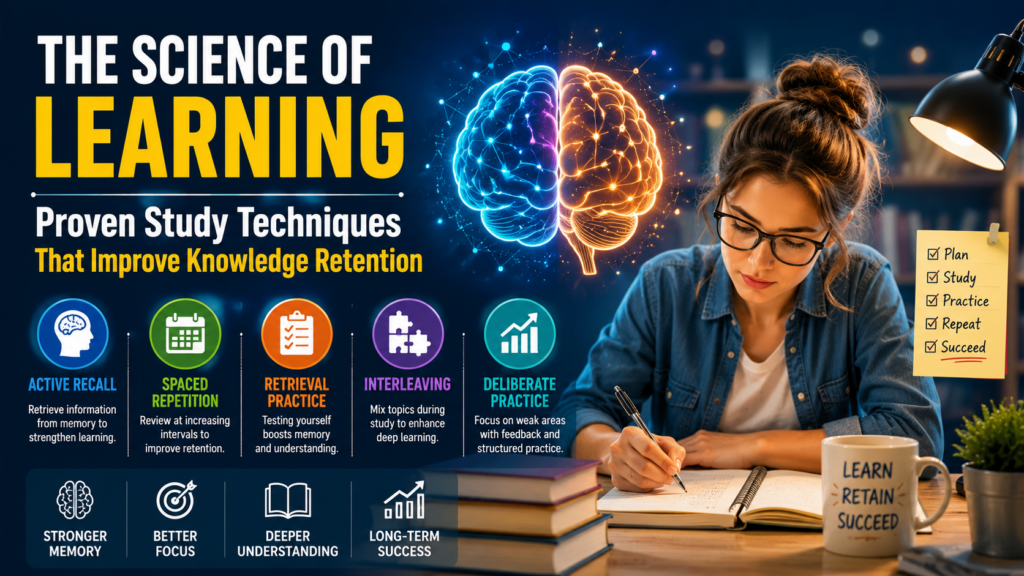
Active recall, spaced repetition, retrieval practice, interleaving, and deliberate practice consistently outperform passive study techniques because they strengthen memory, improve understanding, and support long-term retention.
Whether you are a student preparing for exams, a professional developing new skills, or a lifelong learner pursuing personal growth, applying these evidence-based methods can transform how you learn.
The science is clear: learning becomes more effective when it is active, structured, challenging, and consistent. By understanding how memory works and adopting proven study techniques, you can retain more information, learn faster, and achieve lasting success.