
Big life changes rarely come from big moments. They come from small actions repeated daily. This article explores how simple habits shape behavior, improve health, and build long-term success. You’ll learn practical science-backed methods to build better routines, replace bad habits, and create lasting personal growth step by step.
Why Small Habits Create Big Life Changes
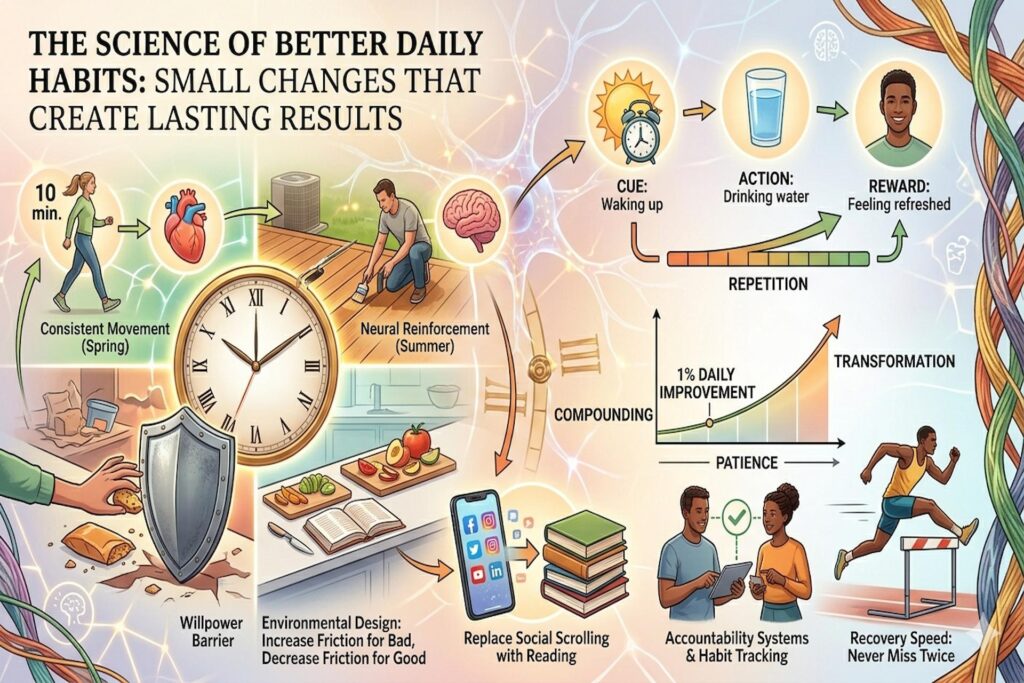
Most people think transformation requires major effort. In reality, lasting change comes from consistency. The brain adapts to repeated actions through neural reinforcement. Each repeated behavior strengthens pathways, making actions easier over time.
This is where the science of behavioral psychology becomes important. It shows that humans don’t rely only on motivation. We rely on patterns. When those patterns are stable, progress becomes automatic.
A 10-minute daily walk, for example, may seem small. But repeated over months, it improves cardiovascular health, mental clarity, and emotional balance. This is how small actions become life-shaping forces.
Key Takeaways
- Small habits compound over time and create major long-term results.
- Behavior is shaped more by environment than willpower alone.
- Habit formation depends on repetition, cues, and rewards.
- Replacing habits is more effective than trying to eliminate them.
- Accountability systems increase consistency and reduce failure rates.
- Progress survives setbacks when routines are simple and flexible.
The Science Behind Habit Formation
Habits follow a simple loop: cue, action, reward. This loop drives most daily behavior.
When a cue triggers an action, and the brain receives a reward, it remembers the pattern. Over time, the action becomes automatic. This is the foundation of habit formation.
The key is repetition. The more consistent the loop, the stronger the habit becomes. Missing occasionally does not break progress, but inconsistency slows it down.
For example:
- Cue: Waking up
- Action: Drinking water
- Reward: Feeling refreshed
Repeat this enough times, and it becomes automatic without effort.
How Environment Shapes Behavior More Than Willpower
People often blame a lack of discipline. But research shows the environment plays a bigger role than motivation.
If snacks are visible, you eat more. If your phone is beside you, distractions increase. This is environmental design, and it quietly controls decisions.
To build better habits:
- Keep healthy options visible
- Remove friction for good habits
- Increase friction for bad habits
A simple shift in surroundings can change behavior without forcing effort. That’s why successful routines are often built through smart setups, not constant self-control.
Replacing Bad Habits Instead of Fighting Them
Trying to remove a habit creates resistance. A better method is substitution. Replace the behavior instead of blocking it.
For example:
- Replace scrolling social media with reading
- Replace sugary drinks with flavored water
- Replace procrastination breaks with short movement sessions
This works because the brain still receives a reward, but in a healthier form. This method aligns with behavioral change strategies used in psychology and coaching systems.
Over time, the new habit becomes stronger than the old one because it serves you better.
Building Accountability Systems That Work
Motivation fades. Systems stay. That’s why accountability is essential for consistency.
Accountability can take many forms:
- Tracking progress daily
- Sharing goals with a friend
- Using habit apps
- Setting public commitments
When someone else knows your goal, your brain treats it with higher importance. This increases follow-through and reduces excuses.
This is especially effective for fitness, learning, and productivity routines. Small external pressure often helps build internal discipline.
Overcoming Setbacks Without Losing Progress
Setbacks are normal. The difference between success and failure is recovery speed.
Missing a day does not matter. Missing a week does. The goal is to return quickly without guilt.
A useful approach is the “never miss twice” rule. If you break a habit one day, restart the next. This keeps momentum alive.
Another helpful method is to reduce expectations temporarily. On difficult days, do a smaller version of the habit. A 2-minute workout is still progress. This keeps identity aligned with action.
How Motivation Actually Works
Motivation is often misunderstood. It doesn’t start the action. Action creates motivation.
When you begin a task, even in small steps, your brain releases dopamine. This builds momentum and makes continuation easier.
This is why starting is the hardest part. Once movement begins, resistance drops.
To use this:
- Start with 2–5 minute versions of habits
- Focus on consistency, not intensity
- Build identity around action, not intention
This approach strengthens long-term discipline naturally.
Creating Routines That Support Growth
Routines reduce decision fatigue. They help you automate important parts of your day so energy is preserved for meaningful work.
A strong routine includes:
- Morning grounding habits (hydration, planning, movement)
- Midday focus blocks (deep work, limited distractions)
- Evening wind-down (reflection, low stimulation, sleep prep)
This structure supports personal growth, wellness, and career performance. It also stabilizes mood and energy levels.
Over time, routines become identity anchors. You don’t think about them. You just do them.
The Power of Compounding Habits
Small actions multiply over time. This is the principle of compounding.
A 1% improvement daily may feel insignificant. But over a year, it transforms outcomes dramatically.
This is how:
- Health improves without extreme diets
- Skills grow without burnout
- Careers progress steadily
- Relationships strengthen through small acts of care
The key is patience. Results are not immediate, but they are inevitable with consistency.
How to Stay Consistent Long-Term
Long-term consistency requires simplicity. Complex systems fail because they rely on too much effort.
Keep habits:
- Easy to start
- Easy to repeat
- Easy to recover if broken
Also, reduce decision points. The fewer choices you make, the more energy you preserve for execution.
Another powerful strategy is linking habits together. For example, after brushing teeth, immediately stretch for two minutes. This creates automatic triggers that reduce resistance.
Final Thoughts
Better habits are not built through dramatic effort. They are built through small, repeated actions that shape identity over time. When you understand how behavior works, change becomes less about willpower and more about structure.
Every small step matters more than it appears. Over weeks and months, those steps build a life that feels more stable, productive, and fulfilling.