
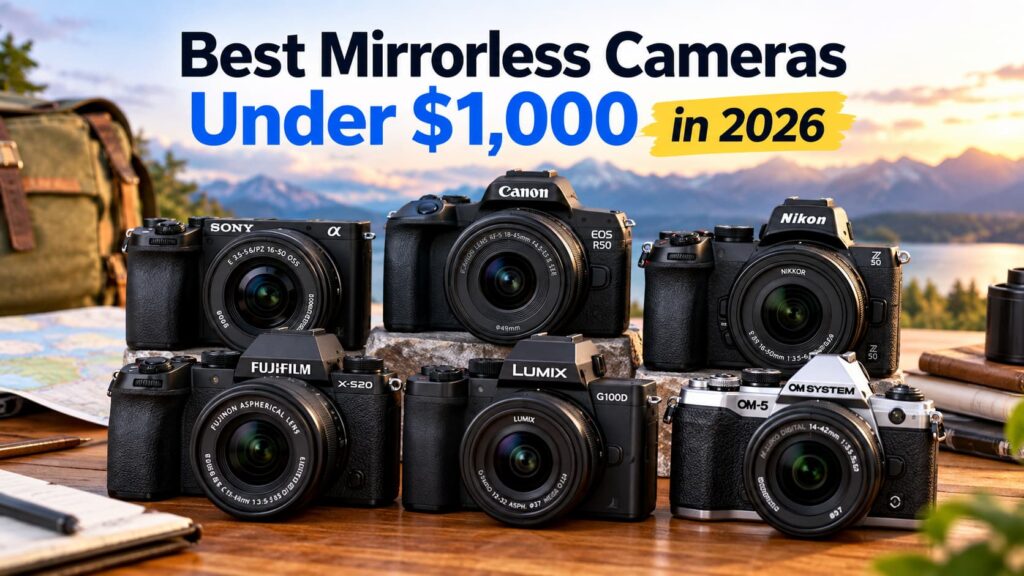
You can still buy a highly capable mirrorless camera for less than $1,000 in 2026, but the strongest choice depends on what you shoot. The Canon EOS R50 stands out for beginners, the Sony a6400 remains attractive for autofocus and lens choice, while the Fujifilm X-M5 offers unusually strong video features for its price. Panasonic and OM System provide useful in-body stabilisation, and Nikon’s Z30 remains a practical creator-focused option.
This shortlist focuses on mirrorless cameras generally available new for about $1,000 or less, considering current pricing, image quality, autofocus, video, stabilisation, handling, lenses and overall value.
6 Best Mirrorless Cameras Under $1,000 at a Glance
| Camera | Best For | Sensor | Video | IBIS | Typical Price |
|---|---|---|---|---|---|
| Canon EOS R50 | Beginners | 24.2MP APS-C | 4K/30p | No | About $680 body |
| Sony a6400 | Autofocus and lens choice | 24.2MP APS-C | 4K/30p | No | About $900 body |
| Fujifilm X-M5 | Hybrid creators | 26.1MP APS-C | 6.2K/30p, 4K/60p | No | $899 body; about $999 kit |
| Panasonic Lumix G97 | Stabilised hybrid shooting | 20.3MP Micro Four Thirds | 4K/30p | Yes | About $848 with 12–60mm lens |
| Nikon Z30 | Vlogging on a budget | 20.9MP APS-C | 4K/30p | No | Roughly $600–$800 depending on kit |
| OM-D E-M10 Mark IV | Lightweight travel photography | 20.3MP Micro Four Thirds | 4K/30p | Yes | $799 body |
Prices are approximate US reference prices and can vary by retailer, country, taxes, promotions and kit configuration.
How We Selected These Cameras
This shortlist is based on editorial research rather than a claim that all six cameras were personally tested side by side. We reviewed manufacturer specifications, current product status, authorised-retailer pricing and independent photography coverage.
Selection factors included sensor size, image quality potential, autofocus, video formats, stabilisation, viewfinder and screen design, size, lens availability, current pricing and suitability for specific users. The order represents different use cases rather than a scientific ranking.
1. Canon EOS R50 — Best for Beginners
The Canon EOS R50 is one of the easiest recommendations for photographers moving beyond a smartphone. It combines a 24.2MP APS-C sensor with Canon’s Dual Pixel CMOS AF system, including subject detection for people, animals and vehicles. It records 4K up to 30p and uses Canon’s RF mount.
At about $680 body-only at the time checked, it leaves room in a $1,000 budget for a basic lens. Its approachable controls, compact size and responsive autofocus are particularly useful for family photography, travel and beginners.
The main compromise is the lack of in-body image stabilisation. Buyers should also compare the cost and availability of suitable RF and RF-S lenses before committing to the system.
2. Sony a6400 — Best for Autofocus and Lens Choice
The Sony a6400 is older than most cameras here, but it remains commercially relevant because Sony still sells it and the E-mount lens ecosystem is extensive. Its 24.2MP APS-C sensor is paired with 425 phase-detection and 425 contrast-detection autofocus points, 11fps continuous shooting and 4K recording up to 30p.
That combination makes it particularly suitable for photography involving people, pets and moving subjects. Current Sony pricing has placed the body around $900 during recent promotions.
Its age does show. There is no in-body stabilisation, and the video feature set is less sophisticated than newer creator-focused cameras such as the Fujifilm X-M5.
3. Fujifilm X-M5 — Best for Hybrid Creators
The Fujifilm X-M5 delivers one of the strongest photo-and-video specifications in this price range. It uses a 26.1MP APS-C X-Trans CMOS 4 sensor with Fujifilm’s X-Processor 5 and can record 6.2K video at about 30p or 4K at up to 60p, including 10-bit recording.
Its compact body, subject-detection autofocus and Fujifilm colour options make it attractive to photographers, vloggers and social creators. Its film simulations may also interest photographers exploring film photography aesthetics without shooting actual film.
B&H currently lists the body at $899 and the 15–45mm kit around $999. The important compromises are no electronic viewfinder and no sensor-shift IBIS. Additionally, 4K/60p uses a crop, and fast camera movement can expose rolling-shutter limitations.
4. Panasonic Lumix G97 — Best for Stabilised Hybrid Shooting
The Panasonic Lumix G97 is particularly interesting because its roughly $848 street price includes a 12–60mm lens rather than only the body. It uses a 20.3MP Micro Four Thirds sensor and includes five-axis in-body stabilisation rated at five stops, 4K/30p recording, V-Log L, an electronic viewfinder and a free-angle screen.
That makes it useful for handheld photography, travel and creators who want both stills and video without immediately buying several accessories. Micro Four Thirds also offers a mature selection of relatively compact lenses.
Its biggest limitation is autofocus. The G97 uses a contrast-detection DFD system rather than the phase-detection systems found in many newer competitors, making it less compelling for demanding action or subject tracking.
5. Nikon Z30 — Best for Vlogging on a Budget
The Nikon Z30 is designed primarily for creators rather than traditional viewfinder-based photography. Its 20.9MP DX-format APS-C sensor records uncropped 4K video up to 30p and Full HD up to 120p, while the vari-angle touchscreen makes self-recording straightforward.
Its small 350g body, microphone support and access to Nikon Z lenses make it a sensible step up from smartphone video. Recent authorised-retailer pricing has placed the body around $607–$807 and the 16–50mm kit around $697–$897 depending on current promotions.
The trade-offs are significant for photographers: there is no electronic viewfinder and no in-body stabilisation. Stabilisation therefore depends on compatible VR lenses or electronic stabilisation for video.
6. OM-D E-M10 Mark IV — Best for Lightweight Travel Photography
The OM-D E-M10 Mark IV remains relevant because it combines a 20.3MP Micro Four Thirds sensor with five-axis in-body stabilisation rated at up to 4.5 stops. It also provides an electronic viewfinder, 4K/30p recording and access to a large Micro Four Thirds lens ecosystem.
Its small body and compact lenses work particularly well for travellers whose travel style prioritises carrying less equipment. OM System currently lists the body at $799.99.
The E-M10 IV is an older design, however. Its 121-point contrast-detection autofocus can struggle more with continuous subject tracking than newer hybrid phase-detection systems, so it is better suited to travel, street, family and everyday photography than serious sports or wildlife.
How to Choose the Right Mirrorless Camera Under $1,000
Sensor size matters, but it should not be your only criterion. APS-C cameras generally provide a larger sensor than Micro Four Thirds models, while Micro Four Thirds can deliver smaller lenses and strong portability.
Lens selection is equally important. A cheap body can become expensive if the lenses you eventually need cost significantly more. Consider wide-angle, portrait and telephoto options before choosing a mount.
Autofocus deserves extra attention if you photograph children, pets, sports or wildlife. Modern subject recognition and phase-detection tracking can make a meaningful difference with moving subjects.
IBIS is particularly useful for handheld photography in lower light and for video. Among this shortlist, Panasonic’s G97 and the E-M10 IV provide sensor-shift stabilisation.
Finally, check whether a quoted price is body-only or includes a lens. A $900 body may ultimately cost more to start using than an $850 camera-and-lens kit.
Frequently Asked Questions
Is $1,000 enough for a good mirrorless camera?
Yes. Several APS-C and Micro Four Thirds cameras provide strong autofocus, 4K video and interchangeable lenses below $1,000. The important question is whether the budget must also cover a lens and accessories.
Should I buy a camera body or a kit with a lens?
A kit is usually more practical for a first interchangeable-lens camera because you can start shooting immediately. Body-only purchases make more sense when you already own compatible lenses or know exactly which lens you want.
Do I need IBIS in a mirrorless camera?
Not necessarily. IBIS is particularly helpful for handheld low-light photography and video, but many cameras without it perform well when paired with stabilised lenses or when shooting at sufficiently fast shutter speeds.
Final Thoughts
There is no single best mirrorless camera under $1,000 for every buyer. The Canon EOS R50 is particularly approachable for beginners, while the Sony a6400 still offers strong autofocus and a mature lens system. Fujifilm’s X-M5 has the most ambitious creator-oriented video specification here, whereas Panasonic and OM System stand out when in-body stabilisation matters.
The Nikon Z30 remains attractive for vloggers who do not require a viewfinder. Before buying, compare the complete system cost rather than the camera body alone, including lenses, batteries, microphones and other accessories you are likely to need.
Editorial Disclosure
Some products mentioned in this article may have commercial relationships with the publisher through advertising, affiliate links, partnerships or other arrangements. Where applicable, such relationships should not automatically determine inclusion or placement. Readers should compare specifications, prices, retailer terms and their own photography requirements before purchasing.
Review Disclaimer
This list is based primarily on editorial research, manufacturer specifications, current pricing information and publicly available independent sources. Unless specifically stated otherwise, inclusion should not be interpreted as evidence that every camera was personally purchased or tested by the editorial team.
Camera pricing, availability, firmware, specifications, bundles and retailer promotions can change. Important details should therefore be confirmed with the manufacturer or retailer before purchase.