
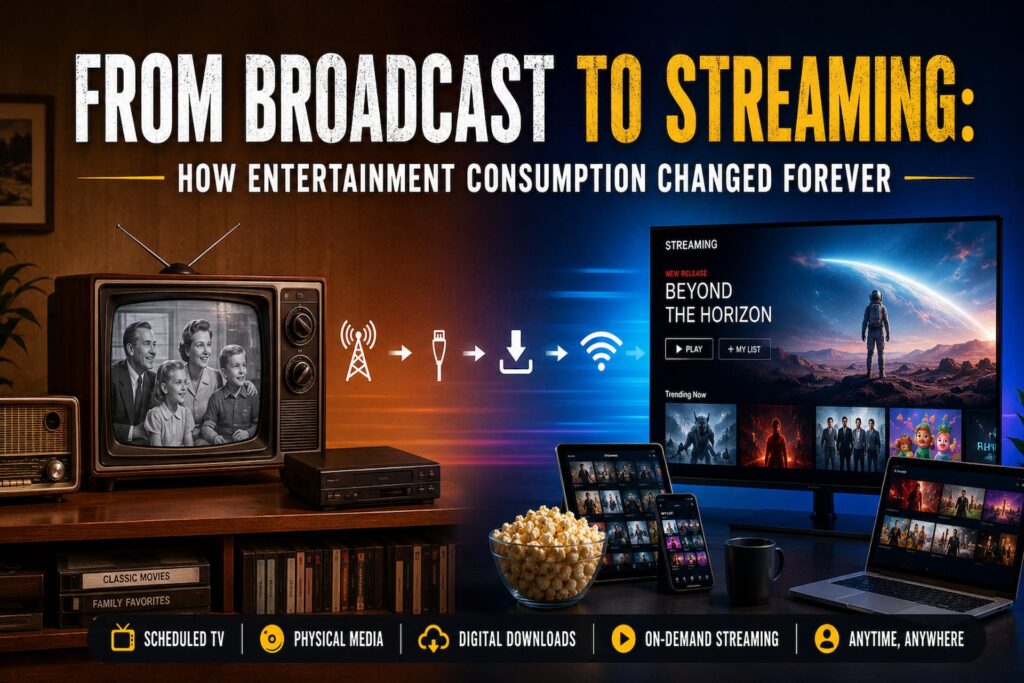
Entertainment has always evolved alongside technology. Every generation has experienced a different way of discovering, accessing, and enjoying movies, television shows, music, and other forms of media. What once required viewers to gather around a television at a specific time has transformed into an experience where almost any content can be watched anywhere and at any moment.
The shift from broadcast television to streaming services represents one of the most significant changes in entertainment history. It has reshaped audience expectations, altered business models, influenced content creation, and expanded access to entertainment on a global scale.
Today, viewers enjoy unprecedented choice and convenience. Yet this transformation did not happen overnight. Understanding how entertainment consumption evolved helps explain why streaming has become such a dominant force and what it means for the future of media.
The Early Days of Broadcast Entertainment
Before streaming platforms existed, entertainment followed a much more structured model.
Radio was the first mass entertainment medium to bring stories, music, and news directly into people’s homes. Families gathered around radios to listen to scheduled programs, creating shared cultural experiences.
Television later expanded this concept. During the mid-20th century, broadcast networks became the primary source of entertainment for millions of households. Viewers watched programs according to fixed schedules, often planning their evenings around favorite shows.
This era was defined by:
- Limited channel choices
- Scheduled programming
- Shared viewing experiences
- Strong audience loyalty
- Mass-market content
Because everyone watched the same programs at roughly the same time, popular shows often became major cultural events.
The Rise of Cable Television
As technology advanced, cable television introduced a new level of variety.
Instead of relying on a handful of broadcast networks, viewers suddenly had access to dozens or even hundreds of channels. Specialized networks emerged to serve different interests, including sports, news, movies, children’s programming, and lifestyle content.
Cable television changed entertainment consumption in several important ways:
More Choice
Audiences no longer depended on a small number of broadcasters. They could select channels aligned with their interests.
Niche Programming
Networks began creating content for specific audiences rather than trying to appeal to everyone.
Premium Content
Subscription channels invested heavily in original programming, paving the way for the premium television era.
Expanded Viewing Hours
With more channels available around the clock, viewers gained greater flexibility in how they consumed media.
Although cable increased options, viewers still remained tied to television schedules and programming timetables.
Physical Media and Personal Ownership
Alongside television, physical media played a major role in entertainment.
Formats such as VHS tapes, DVDs, Blu-ray discs, CDs, and video games allowed consumers to own content rather than simply access it through broadcasters.
This shift introduced several benefits:
- Watch-anytime convenience
- Repeat viewing
- Content collection
- Special features and bonus materials
- Greater control over viewing habits
Video rental stores also became cultural institutions. Renting movies for weekend viewing became a common social activity for families and friends.
For the first time, audiences gained meaningful control over when and how they consumed entertainment.
The Internet Changes Everything
The arrival of widespread internet access fundamentally altered the entertainment landscape.
Initially, internet speeds limited media distribution. Downloading movies or television episodes could take hours. However, as broadband connections improved, digital entertainment became increasingly practical.
Several major developments emerged:
Digital Downloads
Consumers could purchase and download movies, music, and television episodes directly to their devices.
Online Video Platforms
Websites began offering user-generated and professional video content, changing how audiences discovered entertainment.
Portable Entertainment
Laptops, smartphones, and tablets allowed media consumption beyond the living room.
Instant Access
Audiences became accustomed to accessing content immediately rather than waiting for scheduled broadcasts.
This growing demand for convenience laid the foundation for streaming services.
The Birth of Streaming Platforms
Streaming transformed media consumption by eliminating the need for physical ownership or lengthy downloads.
Instead of purchasing individual pieces of content, users could access large libraries through internet-connected devices.
Several factors drove streaming adoption:
- Faster internet connections
- Improved mobile technology
- Affordable data storage
- Cloud-based infrastructure
- Consumer demand for flexibility
Streaming offered something audiences had never experienced before: entertainment available instantly on demand.
Viewers no longer needed to wait for television schedules or visit rental stores. Entire seasons of television shows became available with a few clicks.
The convenience was revolutionary.
The Rise of Binge-Watching Culture
One of streaming’s most significant effects has been the emergence of binge-watching.
Traditional television released episodes weekly. Streaming platforms often release full seasons simultaneously, allowing viewers to watch multiple episodes in one sitting.
Binge-watching changed audience behavior in several ways:
Deeper Engagement
Viewers spend longer periods immersed in stories and characters.
Faster Story Consumption
Narratives unfold over hours rather than months.
Greater Viewer Control
Audiences decide their own viewing pace.
Social Discussion
Online communities discuss entire seasons shortly after release.
This shift has influenced how writers, producers, and studios structure television content.
How Algorithms Personalize Entertainment
Streaming services do more than host content. They actively help viewers discover it.
Recommendation systems analyze viewing behavior and suggest programs based on preferences, watch history, and engagement patterns.
These systems offer several benefits:
- Easier content discovery
- Personalized viewing experiences
- Reduced search time
- Exposure to new genres
- Improved user satisfaction
For many viewers, recommendations have become an important part of entertainment discovery.
At the same time, some critics argue that algorithm-driven recommendations can narrow exposure by repeatedly promoting similar content.
Global Content Becomes Mainstream
One of the most remarkable effects of streaming has been the globalization of entertainment.
In previous decades, international television and films often struggled to reach foreign audiences. Distribution barriers limited access.
Streaming dramatically reduced those barriers.
Today, viewers can easily discover content from different countries, cultures, and languages.
Popular international productions have demonstrated that compelling storytelling can transcend geographic boundaries.
Benefits of global distribution include:
- Greater cultural exchange
- Wider audience reach
- More diverse storytelling
- Increased opportunities for creators
- Broader entertainment choices
Audiences now consume content from around the world in ways that were almost impossible during the broadcast era.
How Streaming Changed Content Creation
The rise of streaming has influenced not only viewers but also creators.
Production companies increasingly design content for streaming audiences rather than traditional television schedules.
Several trends have emerged:
Shorter Seasons
Many streaming series feature fewer episodes with higher production quality.
Serialized Storytelling
Writers can create long-form narratives that unfold across entire seasons.
Data-Informed Decisions
Platforms use viewing data to understand audience preferences.
Greater Creative Freedom
Streaming services often support projects that might not fit traditional network requirements.
As a result, entertainment has become more diverse in both format and subject matter.
The Economics of Subscription Entertainment
Streaming also introduced a new economic model.
Rather than purchasing individual programs, consumers pay recurring subscription fees for access to content libraries.
This model offers advantages:
- Predictable monthly costs
- Large content catalogs
- Continuous access
- Flexible viewing options
However, growing competition has created new challenges.
Many households now subscribe to multiple platforms. As content becomes distributed across different services, consumers often face higher combined costs.
This phenomenon is known as content fragmentation.
The Challenge of Content Fragmentation
In the early streaming era, many viewers enjoyed access to large libraries through a small number of platforms.
Today, the market is far more fragmented.
Different companies often keep exclusive rights to their content, requiring viewers to subscribe to multiple services.
This creates several challenges:
- Subscription fatigue
- Rising entertainment expenses
- Complex content discovery
- Frequent platform switching
As competition increases, companies continue searching for ways to balance exclusivity with accessibility.
Mobile Viewing and Entertainment Anywhere
Another major shift involves mobility.
Entertainment is no longer tied to a television screen.
People now watch content:
- During commutes
- While traveling
- During breaks at work
- On smartphones and tablets
- Across multiple devices
This flexibility has transformed media consumption habits and increased total viewing opportunities throughout the day.
Entertainment has become integrated into everyday life in ways previous generations could not have imagined.
What Hasn’t Changed?
Despite enormous technological changes, some aspects of entertainment remain remarkably consistent.
Audiences still seek:
- Great storytelling
- Memorable characters
- Emotional connections
- Shared experiences
- Meaningful cultural conversations
Technology changes delivery methods, but human interest in stories remains the foundation of entertainment.
Whether content arrives through radio, broadcast television, cable networks, DVDs, or streaming platforms, compelling stories continue to drive audience engagement.
The Future of Entertainment Consumption
The evolution of entertainment is far from over.
Several long-term trends are likely to continue shaping the industry:
- Greater personalization
- Expanded global distribution
- Interactive viewing experiences
- Enhanced recommendation technology
- Continued growth of mobile entertainment
- Hybrid subscription and advertising models
Future innovations may change how audiences access content, but convenience, flexibility, and personalization will likely remain central priorities.
As technology evolves, entertainment consumption will continue adapting to meet changing viewer expectations.
Questions & Answers
1. What is the biggest difference between broadcast television and streaming?
Broadcast television follows fixed schedules, while streaming allows viewers to watch content on demand whenever they choose.
2. Why has binge-watching become so popular?
Streaming platforms often release entire seasons at once, allowing viewers to watch multiple episodes without waiting for weekly broadcasts.
3. How do streaming platforms recommend content?
They use algorithms that analyze viewing habits, preferences, and watch history to suggest relevant movies and television shows.
4. What is content fragmentation?
Content fragmentation occurs when entertainment is spread across multiple streaming services, requiring viewers to use several subscriptions.
5. Has streaming increased access to international content?
Yes. Streaming platforms make it easier for audiences worldwide to discover and watch movies and television shows from different countries.
The Takeaway
The journey from broadcast television to streaming platforms represents one of the most significant transformations in media history. Entertainment has moved from fixed schedules and limited choices to an on-demand ecosystem defined by flexibility, personalization, and global accessibility.
Streaming has empowered audiences with unprecedented control while creating new opportunities for creators and distributors. It has reshaped viewing habits, introduced binge-watching culture, expanded international content discovery, and transformed business models across the entertainment industry.
While technology will continue evolving, the core purpose of entertainment remains unchanged. People still seek stories that inform, inspire, entertain, and connect them with others. The methods may change, but the human desire for meaningful storytelling endures.